Mostrando entradas con la etiqueta Parques Eólicos. Mostrar todas las entradas

13/9/23

POST-CONSTRUCTION BIRD AND BAT FATALITY MONITORING FOR ONSHORE WIND ENERGY FACILITIES IN EMERGING MARKET COUNTRIES. GOOD PRACTICE HANDBOOK AND DECISION SUPPORT TOOL

 
  • IFC 2023. Post-Construction Bird and Bat Fatality Monitoring for Onshore Wind Energy Facilities in Emerging Market Countries. Good Practice Handbook and Decision Support Tool. International Finance Corporation- European Bank for Reconstruction and Development- KfW Group, 176 pp. [PDF
 

28/8/23

PROCEEDINGS OF THE 14 TH WIND-WILDLIFE RESEARCH MEETING

Abstract

The anticipated build-out of renewable energy development over the next 10 to 15 years is staggering, presenting both challenges and barriers in the path toward mitigating climate change through an energy transition that simultaneously facilitates wildlife conservation. Solving this immense challenge will require work across sectors to identify and evaluate solutions. These proceedings document current research pertaining to wind energy-related wildlife impacts from collision and displacement; the cumulative and potential population-level effects from both climate change and wind energy development; and technological advances to avoid, minimize, and offset these impacts. As the window of opportunity to prevent the most catastrophic consequences of climate change narrows, these proceedings reflect discussions among stakeholders -scientists, government wildlife agencies, wind energy developers, and conservation organizations- who are working to understand and develop solutions to mitigate risk to wildlife from wind, on and offshore, as we work to meet renewable energy targets to mitigate climate change.

  • PNWWRM XIV. 2023. Proceedings of the 14 th Wind-Wildlife Research Meeting. November 15-17, 2022. Prepared by the Renewable Energy Wildlife Institute, Washington, DC, K.E. Johnson, ed. 109 pp. [PDF

21/4/23

NATURAL CAPITAL BEST PRACTICE GUIDANCE. INCREASING BIODIVERSITY AT ALL STAGES OF A SOLAR FARM’S LIFECYCLE

Purpose & intended audience

This best practice guidance has been produced to raise awareness and promote the design, construction and operation of high-quality solar farm projects which support ecology and deliver additional benefits arising from multiple land use. It provides detailed guidance on how to deliver a solar farm from site design through to decommissioning with an emphasis on promoting environments which provide natural capital, biodiversity, and in some cases agriculture, alongside green energy supply. Most Local Planning Authorities (LPAs) will by now have some experience with the consenting process for renewable energy technologies, however many may be unaware of the specific opportunities for solar farms to improve biodiversity and increase ecosystem services. Solar farms can be a critical tool for LPAs to achieve both their climate and ecological objectives. Solar farm developers should also find this guide useful in the development, construction, and operation of sites. It has been designed to clearly set out the benefits of implementing biodiversity enhancement strategies alongside maximising the output of solar installations. This has progressed considerably in the past few years, presenting exciting new financial opportunities as well.

  • Solar Energy UK. (2022). Natural capital best practice guidance. Increasing biodiversity at all stages of a solar farm’s lifecycle. Solar Energy UK. 34 pp. [PDF]

15/11/22

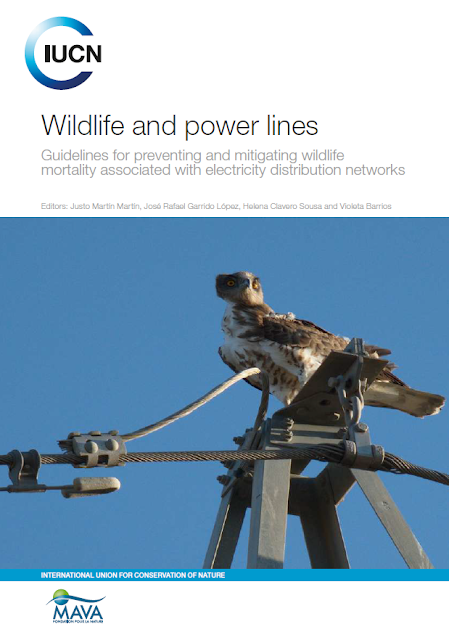
WILDLIFE AND POWER LINES. GUIDELINES FOR PREVENTING AND MITIGATING WILDLIFE MORTALITY ASSOCIATED WITH ELECTRICITY DISTRIBUTION NETWORKS

Abstract

Given the vital role of power lines for social development, the rapid spread of such infrastructure worldwide and the fact that power lines can be one of the main causes of direct mortality for several species of birds and other wildlife, including mammals, it is essential to have suitable tools to ensure that these lines are built and maintained in accordance with environmentally friendly principles, and that priority is given to avoiding and reducing negative impacts. This manual is intended to be a technical guide for use by all stakeholders, from companies and businesses in the energy sector to authorities and government planners, investors and civil society. It contains recommendations and standard good practices for avoiding the adverse effects of new power lines and managing risks early in the process, so as to ensure that infrastructure expansion takes account of biodiversity in the spatial planning and early project implementation phases, when they will be most effective. It also contains case studies from around the globe.
 
  • Martín et al. (Eds.) (2022). Wildlife and Power Lines. Guidelines for Preventing and Mitigating Wildlife Mortality Associated with Electricity Distribution Networks. Gland, Switzerland, IUCN. [PDF]

26/10/22

ELECTROCUTIONS & COLLISIONS OF BIRDS IN EU COUNTRIES: THE NEGATIVE IMPACT & BEST PRACTICES FOR MITIGATION


Foreword

Electric power is still regarded to be a major benefit for humankind, but it is also turning out to be a significant threat for wildlife. Transmission and distribution electricity grids are expanding rapidly worldwide with significant negative impacts on biodiversity. Unfortunately, the routes of Eurasian migratory birds are often concentrated in the regions where mankind has erected the most elaborate networks of electric power lines.

In recent years, awareness has risen surrounding the dangerous interactions of birds and electric power lines. Electrocution and collisions are substantial mortality factors for numerous bird species, despite the increasing number of mitigation measures implemented worldwide. The risk of powerlines for birds is still an underestimated reason for mortality in some countries and regions and, overall, the data are either missing or absolutely insufficient. Hence, there is neither a legal setting for the mitigation of collisions with power lines, nor for electrocution. In some countries, only sporadic data are recorded by local experts and the wider public. Nevertheless, despite the fact that greater investment in scientific research aimed at bridging gaps is needed - current knowledge already offers a solid basis for actions to improve the safety of electric power lines.

This document provides a general overview of the current handling and knowledge of the ’birds vs. power lines’ issue at national level in all 27 European (EU) member states through responses to a questionnaire prepared by Raptor Protection of Slovakia. The questionnaire was sent to a number of non-governmental organisations, Bird Life International offices, and electric utility companies. Unfortunately, low-quality information was retrieved from some countries. This possibly reflects the fact that available information on the subject of bird-power line interactions is genuinely limited and/or that relevant stakeholders are just not aware of the topic. Nevertheless, some of the missing information could be retrieved from scientific (and other) publications and documents. Through these sources, it was possible to prepare this document to present an up-to-date account of the scale and impact of electrocution and collision of birds with power lines. It also provides recommendations for actions and examples of best practices to reduce bird mortality.

We hope that this short overview can serve as a framework for implementing best practice standards to reduce bird mortalities, to document utility actions, to improve service reliability, and to comply with bird protection laws in the EU. An EU-wide implementation can set the ground for adaption in flyway regions with extraordinary demand for effective practical measures like the Balkans, Middle East, or East Africa.

Raptor Protection of Slovakia

 
  • Raptor Protection of Slovakia (2021). Electrocutions & Collisions of Birds in EU Countries: The Negative Impact & Best Practices for Mitigation. Raptor Protection of Slovakia-Nature and Biodiversity Conservation Union/BirdLife Germany (NABU). 103 pp. [PDF]


12/1/21

SUMMARY OF BAT FATALITY MONITORING DATA CONTAINED IN AWWIC. 2ND EDITION

 
KEY TAKEAWAYS

AWWIC has sufficient data, with enough geographic coverage, for investigators to pose reasonable hypotheses about the impacts of wind energy on bat species in the U.S. These hypotheses can be re-evaluated as data from additional PCM studies are added to AWWIC.

Findings indicate substantial variation in collision risk among bat species with most fatalities concentrated among a few species. Three species of migratory tree bat accounted for 72% of all bat fatality incidents in AWWIC, and the eight bat species with the highest number of fatalities accounted for 96% of all fatality incidents.

Species composition of fatalities and adjusted fatality estimates vary substantially across geographic regions. Evaluation of this variation may improve our knowledge of why some bats in some regions have apparent high collision risk.

Accurate cumulative assessments of wind energy’s impacts on bats need to account for the geographic variation in numbers and variation among species in collision fatalities. 
 

  • American Wind Wildlife Institute (AWWI). 2020. Summary of Bat Fatality Monitoring Data Contained in AWWIC (2nd Edition). Washington, DC. [PDF]
  • American Wind Wildlife Institute (AWWI). 2020. AWWI Technical Report: 2nd Edition: Summary of Bat Fatality Monitoring Data Contained in AWWIC. Washington, DC. [PDF]

18/8/20

FACTORS AFFECTING CARCASS DETECTION AT WIND FARMS USING DOGS AND HUMAN SEARCHERS

Orgullosos de poder dejaros la infografía divulgativa de nuestra investigación sobre la efectividad de perros y humanos en la detección de la mortalidad de aves y murciélagos en parques eólicos.

Este trabajo ha permitido despejar algunas dudas sobre la influencia de las variables ambientales en la capacidad de los buscadores a la hora de localizar restos de fauna accidentada en aerogeneradores. Hemos observado que los perros adiestrados obtuvieron tasas de éxito significativamente más elevadas en todas las condiciones analizadas, pero especialmente en situaciones de vegetación densa y con las especies de menor tamaño. Mientras que los humanos solo obtuvieron un éxito aceptable cuando el entorno de prospección estaba muy despejado y el objetivo eran las especies de mayor envergadura.

Los resultados reflejan las grandes limitaciones de los controles convencionales de mortalidad de fauna en infraestructuras, e invitan a reflexionar sobre la idoneidad de los protocolos actuales y sobre la necesidad de reenfocar las vigilancias ambientales.

Os dejo el póster y a continuación el resumen en inglés y español de la publicación original. Se agradece la difusión. 


Abstract

  • The use of detection dogs to effectively monitor bird and bat fatalities at wind farms is becoming increasingly popular. All studies to date agree that dogs outperform human searchers at finding bird and bat carcasses around wind turbines; however, it remains unclear how characteristics of the carcass and environmental conditions during the search may influence detection.
  • We investigate the effect of carcass size, vegetation characteristics and weather conditions on the probability of detecting a carcass, for both dogs and humans, using data from the monitoring program of a wind farm in Spain.
  • A generalized linear mixed model reveals a high performance of dogs (~80% detection rate), with no clear influence of any of the variables analysed. Humans, on the contrary, were markedly affected by the size of the carcass and to some extent, by the vegetation structure. Humans performed poorly at detecting small carcasses (~20% detection rate), more so in closed vegetation.
  • Synthesis and applications. Our results provide evidence that dogs perform with high success rates at detecting bird and bat carcasses of different sizes under a wide range of environmental conditions. Humans, by contrast, were very poor at detecting all but the largest carcasses in open areas. We find the use of detection dogs at wind farms to be a robust and cost‐effective alternative to using human searchers, most notably, when the focus is on the monitoring of fatalities of small, rare or inconspicuous species in closed vegetation.


Resumen

  • El interés por el uso de perros adiestrados para el control de la mortalidad de aves y murciélagos en parques eólicos se ha incrementado en los últimos tiempos. Y aunque los perros han obtenido rendimientos superiores a los humanos en todos los ensayos realizados, aún quedan por aclarar cuestiones sobre la influencia de las características de los restos o las condiciones ambientales en la capacidad de detección.
  • Analizamos la influencia del tamaño de los restos, las características de la vegetación y las condiciones meteorológicas en la capacidad de detección de perros y humanos, a través de los datos recogidos en un programa de control ambiental de un parque eólico en España.
  • Utilizando un modelo general lineal mixto mostramos que los perros mantienen un alto rendimiento independientemente de la influencia de las variables analizadas (índice de detección ~80%). En cambio, los buscadores humanos se ven marcadamente afectados por el tamaño del cadáver y, en menor medida, por la estructura de la vegetación (índice de detección ~20%). De hecho, mostraron eficacias muy bajas con las especies más pequeñas y en ambientes de vegetación cerrada.
  • Síntesis y aplicaciones. Nuestros resultados reflejan que los perros mantienen índices de detección de aves y murciélagos elevados en todo el rango de tamaños y condiciones ambientales analizados. Por el contrario, el rendimiento de los buscadores humanos es en general muy bajo, salvo en la localización de cadáveres grandes en ambientes abiertos. Consideramos que los perros adiestrados son una alternativa rentable y menos sesgada que los buscadores humanos para el control de la mortalidad de fauna en parques eólicos, especialmente cuando el objetivo es la detección de especies pequeñas, raras o poco visibles en ambientes de vegetación densa.


REFERENCE / REFERENCIA

  • Domínguez J., Cervantes, F. & Jaquero, M.I. 2020. Factors affecting carcass detection at wind farms using dogs and human searchers. Journal of Applied Ecology 57: 1926-1935. https://doi.org/10.1111/1365-2664.13714